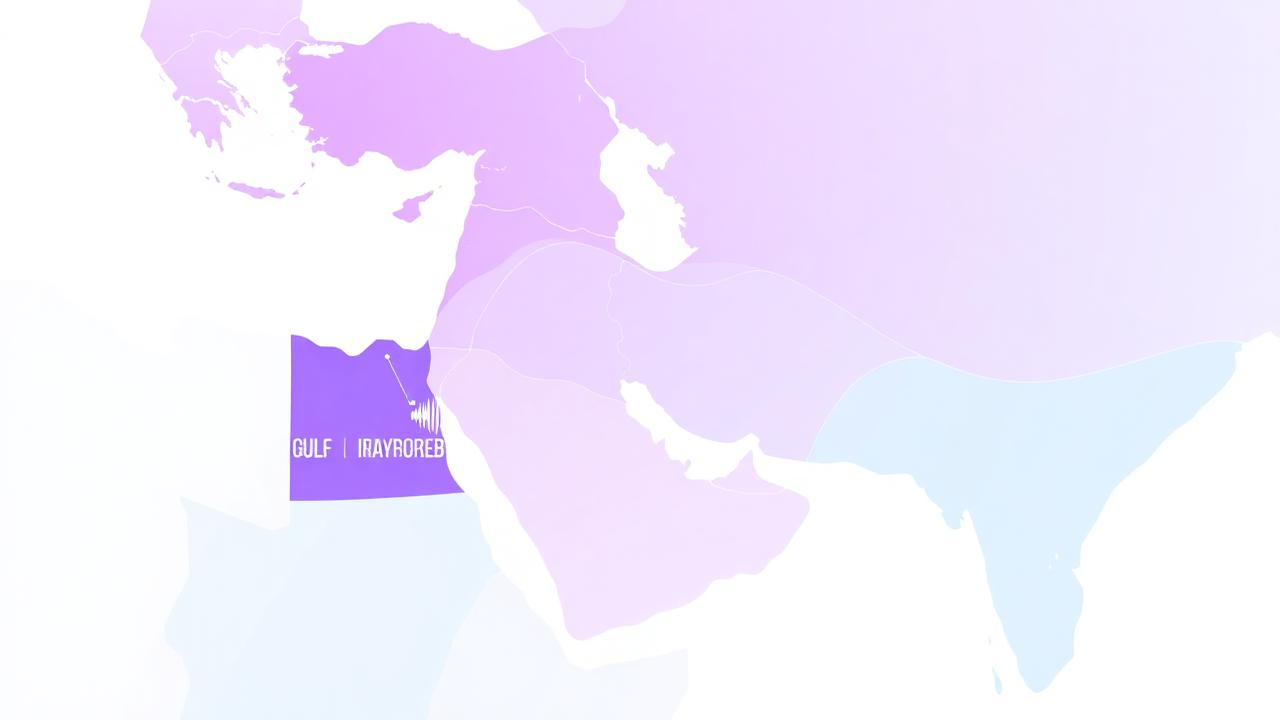
Outside Egypt, the Arabic-speaking world splits roughly into three large dialect families: Gulf Arabic across the Arabian Peninsula, Levantine Arabic across Syria, Lebanon, Jordan, and Palestine, and Maghrebi Arabic across Morocco, Algeria, Tunisia, and Libya. They share a common ancestor and a common written language, and on a good day speakers across the three regions can hold a conversation. But for AI systems — which do not have the benefit of context, gestures, or patience — the differences are deep enough that you cannot treat them as a single language.
Gulf Arabic: the language of the Peninsula
Gulf Arabic, sometimes called Khaleeji, is spoken across Saudi Arabia, the UAE, Kuwait, Qatar, Bahrain, and Oman, with closely related varieties in Iraq and Yemen. Its defining feature for AI teams is the realization of the MSA letter qaf as a hard g — Qatar becomes Gatar, and the verb to say is gal rather than qala. The letter jim is usually a y in older Gulf varieties and a j in more urban speech.
Vocabulary is heavily influenced by Persian, Hindi, and Swahili, reflecting centuries of trade across the Indian Ocean. Words like dirisha (window) in Omani Arabic come straight from Swahili; bukra (tomorrow) is shared across Gulf and Levantine but pronounced and stressed differently. Grammar retains more features of Classical Arabic than other dialect families, including the use of the dual number and richer verb morphology.
For voice AI, the practical implication is that a Gulf speaker dictating a message will use g where the spelling shows q, will drop short vowels in ways that confuse MSA-trained models, and will mix in English loanwords at a high rate, especially in younger urban populations. A Gulf-ready dataset needs explicit coverage of Saudi, Emirati, Kuwaiti, and Qatari speakers; lumping them together loses the acoustic detail that matters.
Levantine Arabic: the language of the eastern Mediterranean
Levantine Arabic covers Syria, Lebanon, Jordan, and Palestine, with notable urban-rural splits inside each country. The most recognizable feature is the realization of qaf as a glottal stop in major cities — Beirut becomes ʔaa-bayrut and a coffee is a ʔahwe. Rural and southern speakers often retain the q. The letter jim is consistently a soft j, similar to English.
Levantine vocabulary borrows from Aramaic, Turkish, French, and English. Sentence melody is famously musical, with rising intonation patterns that make Lebanese Arabic instantly recognizable in pan-Arab media. Negation uses ما before the verb and sometimes a suffixed ش after it, a pattern shared with Egyptian but executed with different rhythm and stress.
Because Lebanese and Syrian artists have a strong presence in pan-Arab music and television, Levantine Arabic is the second-most widely understood dialect after Egyptian. For AI products targeting media, hospitality, or diaspora communities in Europe and the Americas, Levantine coverage is essential. Within the family, Lebanese, Syrian, Jordanian, and Palestinian Arabic each have distinctive acoustic signatures that a serious dataset will track separately.
Maghrebi Arabic: the language of North Africa
Maghrebi Arabic — spoken in Morocco, Algeria, Tunisia, and Libya — is the dialect family most often left out of pan-Arab datasets, and it is also the family where that omission hurts the most. Maghrebi varieties developed in close contact with Berber languages, with strong layers of French and Spanish borrowing on top. The result is a dialect that even other Arabs find difficult to follow at full speed.
Phonologically, Maghrebi Arabic compresses short vowels aggressively, producing dense consonant clusters that violate the syllable structure of MSA. Words can be reduced to what sounds like a single beat of consonants and a vowel. Vocabulary is rich with Berber roots and French loanwords used as fully integrated Arabic verbs and nouns. Negation uses a wrap-around ma...sh pattern similar to Egyptian, but with very different intonation.
For AI teams, Maghrebi Arabic requires its own data pipeline. Models trained on Egyptian and Gulf data will fail on Moroccan or Algerian speech, even after fine-tuning, because the acoustic patterns are fundamentally different. If your product serves North Africa, plan for dedicated Moroccan and Algerian collection — and treat Tunisian and Libyan as separate slices with their own annotators.
Code-switching and the European layer
All three dialect families code-switch with European languages, but the patterns differ. Gulf speakers mix in English in technology, business, and youth contexts. Levantine speakers mix English and French in similar contexts, with a long Francophone tradition in Lebanon. Maghrebi speakers mix French and, in northern Morocco, Spanish at extraordinarily high rates — entire sentences may alternate between Arabic and French within a single utterance.
Datasets and ASR models must be designed for this reality. A monolingual Arabic model will treat code-switched words as noise. The right approach is to label code-switched tokens explicitly, support mixed-language transcription, and evaluate model performance on naturally code-switched test sets — not on artificially monolingual ones.
Practical guidance for dialect-aware AI
Choose dialects based on your users, not on convenience. A regional fintech serving the Gulf does not need Maghrebi data; a North African telecom does not need deep Gulf coverage. Most successful Arabic AI deployments start with one or two anchor dialects, ship to those markets, and expand based on real user data.
Inside each family, balance subregions explicitly. Saudi Hejazi and Najdi Arabic are not interchangeable. Lebanese and Jordanian Arabic are not interchangeable. Moroccan and Algerian Arabic are definitely not interchangeable. Treat each as a first-class slice of your dataset, with its own speakers, annotators, and evaluation metrics.
The Arab world is not a monolith. The teams that ship the best Arabic AI are the ones that treat each dialect family as the distinct linguistic and cultural reality it is — and build their data, models, and evaluations accordingly.